

Check-in never lands at a calm moment. Guests arrive tired, suitcases across the hallway, and that is exactly when you have to ask for the document, write down ten details per person and get a signature on top.
Improvising on a blank sheet costs you later: the gap you left shows up once the guest has gone up to the room, or worse, when SES.HOSPEDAJES bounces the parte de viajeros back. Hence this template, with the fields laid out in the order you’ll actually fill them in.
What the free guest report template includes
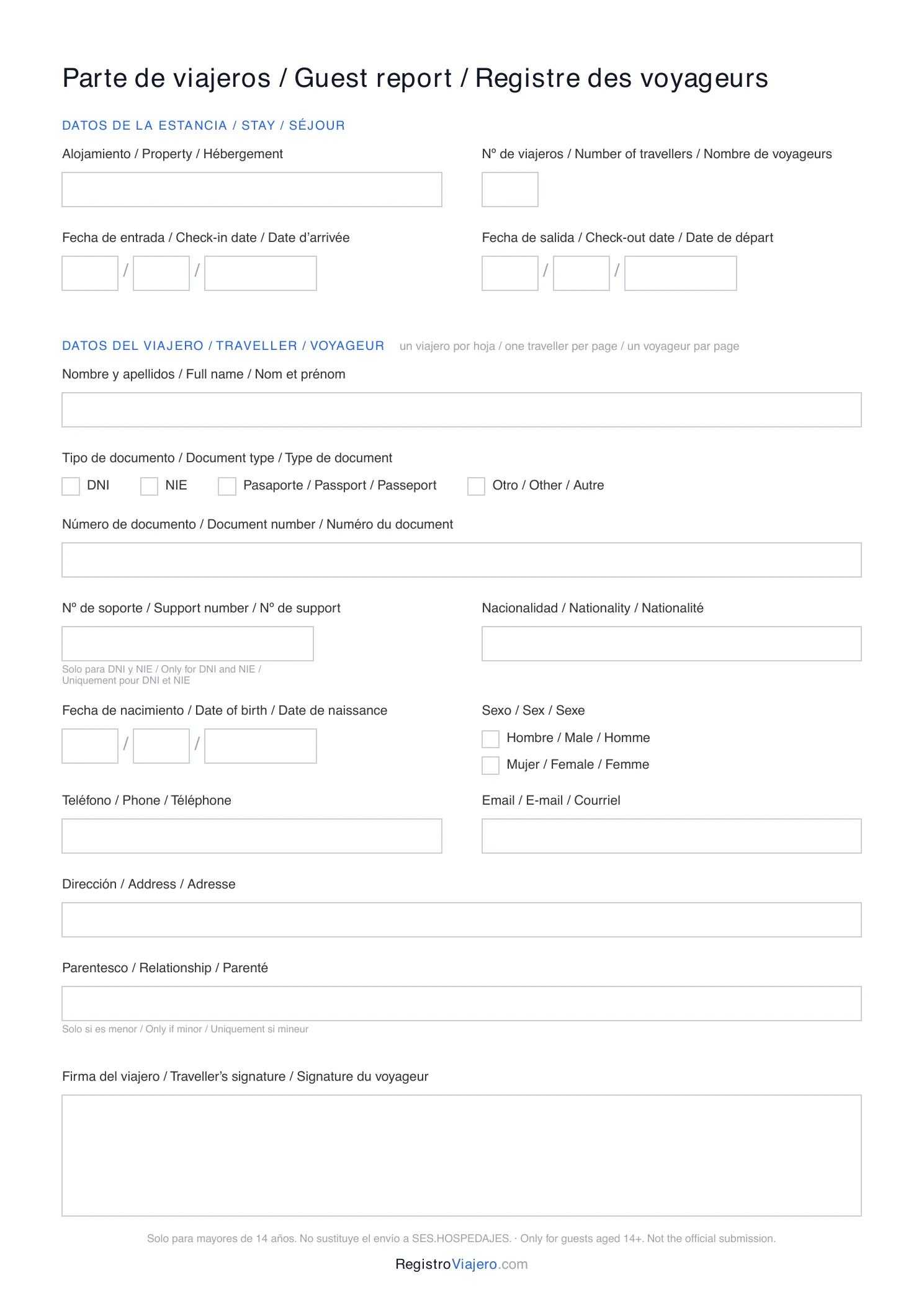
The template captures the two blocks of data the rule asks for1: the stay and each traveler.
- Accommodation and stay: property, number of travellers, check-in date and check-out date.
- Each traveler: full name, document type and number, document support number (only for DNI and NIE), nationality, sex, date of birth, address, phone and email.
- Traveler’s signature, which the rule requires from age 14, and, when a minor travels, their relationship to the accompanying adult.
The sheet carries one traveller per page, so for a group you print or save one per person, repeating the stay block at the top.
Labels are printed in Spanish, English and French, so a foreign guest understands what’s being asked without improvised translations. The gaps are sized for normal handwriting in pen, not for squeezing in tiny print.
The PDF is dynamic: you don’t have to print it. Type straight into the fields on your computer, copy and paste each booking’s data, and save it. Or print it and fill it in by hand. Your choice.
Download the Spanish guest report template
A one-page PDF you fill in on your computer by copy-pasting the data, or print to write by hand.
- RD 933/2021 fields
- ES · EN · FR
Done! Here’s your template
Download it and fill it in on your computer, or print it to do it by hand.
Download templateWhere the template’s fields come from: RD 933/2021
We didn’t make them up: these are the identification details RD 933/2021 requires you to collect and report for every traveler1. The signature is what changes with age: article 4.2 only requires it from 142. The document support number (the code on the DNI or NIE card) is one of the most commonly forgotten fields, and Annex I lists it with no qualifier attached1.
That expanded data set started being required on 2 December 2024, the day the Spanish Interior Ministry switched SES.HOSPEDAJES on after successive postponements3. That is why a form predating it comes up short.
We left out anything that doesn’t serve compliance so the sheet fits on a single side and stays legible. For the detail on the rule, the reporting deadline and the penalties, see our guide to the guest report and RD 933/2021.
The four fields people get wrong most
The rest of the form fills itself in. These four are the ones that come back rejected when you later pass them to SES.HOSPEDAJES:
Document support number. Not the DNI number. It’s on the front, the photo side, and you find it by its label, which changes with the version of the card: NUM SOPORTE on the current DNI, NUM SOPORT on those issued from 2015 to 2021, and IDESP on those from 2006 to 2015. It is three letters and six digits run together, no spaces or dashes, and it changes every time the document is renewed. The version-by-version map is in the DNI support number, and the immigration-document one, with its E plus eight digits, in the NIE support number. It’s the field that kills the most reports, simply because plenty of people don’t know it exists. If yours bounces, the diagnosis is in the error code guide.
Both surnames, kept separate. The system expects first surname and second surname in different fields. For foreign guests who only have one, fill the first and leave the second empty. Don’t invent one or repeat it.
Relationship, only when a minor is travelling. You record the minor’s relationship to the accompanying adult. From age 14 the minor gets a full registration of their own; below that, the rule doesn’t require them to have their own document. The age-by-age detail is in minors on the guest report.
Date of birth in full. Four-digit year. A “65” instead of “1965” is a guaranteed rejection.
When the paper template helps (and when it isn’t enough)
It’s your paper safety net: for when the wifi drops on arrival day, for when you’d rather the guest just sign at the table, or as a copy you keep on file. What it doesn’t do is file for you. The report still has to reach SES.HOSPEDAJES immediately and, at the latest, within 24 hours of the stay starting4. The data itself is then kept for three years from the end of the contracted service5.
If filling in reports by hand repeats with every booking, the next step is to let the guest enter their own details before arrival. That’s exactly what RegistroViajero does: digital check-in in nine languages, validation of the required fields, and submission to SES.HOSPEDAJES without typing document by document. See how the step-by-step SES.HOSPEDAJES submission works, or what to do if you need to cancel or correct a report already sent.
Frequently asked questions
Does filling this in satisfy the obligation? No, filling this in does not satisfy the obligation on its own. The report has to be filed electronically with SES.HOSPEDAJES within 24 hours of the start of the stay. This PDF is for collecting the data in order and getting the traveller’s signature; submission is a separate step.
Is there a Word version? There is no Word version, PDF only. The reason is practical: a PDF holds its layout on any computer and stops the fields shifting when it opens. Because it’s a form PDF, you can type straight into it without printing, which is usually what people are after when they ask for Word.
Can I still use a 2024 guest report template? Whether a 2024 guest report template still works depends which one it is. Electronic filing through SES.HOSPEDAJES began on 2 December 2024 with the expanded data set from RD 933/2021. Forms predating that tend to be short of fields, and the one most often missing is the document support number. If your sheet doesn’t ask for it, it’s out of date.
How many travellers fit on one sheet? One traveller fits on one sheet: the template says so in the header of the traveller block, “one traveller per page”. If a group arrives, print or save one sheet per person, repeating the stay details at the top. The group’s total number of travellers has its own field in that block.
How long do I have to keep it? You have to keep it for three years: that is the retention period RD 933/2021 sets for the information. If you keep the signed sheet on paper, plan on storing it for that long, with the data protection duties that implies. Keeping it does not substitute for having filed the report.
Sources
-
Real Decreto 933/2021, Annex I, section A) items 3 and 4, consolidated text (BOE). ↩ ↩2 ↩3
-
Real Decreto 933/2021, article 4.2, consolidated text (BOE). ↩
-
Interior activa el nuevo registro de hospedaje y alquiler de vehículos, press release of 2 December 2024 (Spanish Ministry of the Interior, La Moncloa), accessed 14 August 2026. ↩
-
Real Decreto 933/2021, article 6.3, consolidated text (BOE). ↩
-
Real Decreto 933/2021, article 5.3, consolidated text (BOE). ↩